Planning a custom home in Alberta involves navigating land acquisition, permit approvals, builder selection, and construction timelines that vary significantly by municipality and region. Alberta's climate, lot conditions, and material costs create unique challenges that generic building guides don't address. Understanding each phase before you commit protects your budget and timeline from avoidable surprises.
Most people who've built a custom home in Alberta will tell you the same thing: the process was more involved than they expected, and the decisions made in the first few months shaped everything that followed. Whether you're building in the foothills outside Calgary, a rural acreage near Red Deer, or a new subdivision in Edmonton's expanding fringe, the planning stage is where your project either gets a solid foundation or quietly starts to unravel.
This guide cuts through the surface-level advice and walks you through what the planning process actually looks like, including realistic costs, common traps, and the decisions that matter most.
Key Takeaways
- Custom home planning in Alberta typically spans 6 to 18 months before a shovel hits the ground, depending on land status and permit complexity.
- Alberta's climate demands specific foundation and insulation decisions that directly affect long-term energy performance and resale value.
- Builder selection is the single highest-leverage decision in the entire process — the wrong fit costs far more than the price difference suggests.
- Municipal permit timelines vary widely across Alberta, with rural counties sometimes taking longer than urban centres due to staffing and infrastructure review requirements.
- Budget contingencies of 15 to 20 percent are standard practice for custom builds, not conservative pessimism.
- Land cost, soil conditions, and utility servicing are often underestimated line items that catch first-time builders off guard.

Why Alberta Isn't Like Building Anywhere Else in Canada
Alberta's geography creates real building conditions that affect your plan before a single design decision gets made. The province spans prairie flatlands, river valley lots, and mountain-adjacent terrain, each with different soil profiles, frost depth requirements, and utility access realities.
Alberta's frost penetration depth ranges from 1.5 metres in southern regions to over 2.4 metres in northern parts of the province. This directly affects foundation design requirements and excavation costs, which can vary by $15,000 to $40,000 depending on location and soil bearing capacity.
Chinook conditions in central and southern Alberta also create freeze-thaw cycles that influence foundation movement more than in areas with stable cold winters. Builders with local experience account for this in their footing design; those without it sometimes don't.
Municipal differences add another layer. Calgary, Edmonton, Lethbridge, and Red Deer each operate their own development permit processes with distinct timelines and documentation requirements. Rural municipalities and counties follow the Municipal Government Act but handle applications with significantly smaller planning departments, which can slow approvals even for straightforward builds.
What Does It Actually Cost to Build Custom in Alberta?
Custom home construction costs in Alberta typically range from $250 to $550 per square foot for the build itself, not including land. Entry-level custom builds with standard finishes sit closer to $250 to $300 per square foot, while mid-range to high-end custom homes with upgraded mechanical systems, custom millwork, and premium cladding regularly reach $400 to $550 per square foot or more.
Land cost varies enormously. A serviced lot in a Calgary suburb runs differently than a raw acreage in Parkland County that requires a well, septic system, and driveway installation. First-time builders often budget for the house and forget to fully account for site development. For a detailed breakdown, the cost to build a custom home Alberta resource covers these line items more specifically.

Step-by-Step: How to Plan a Custom Home in Alberta
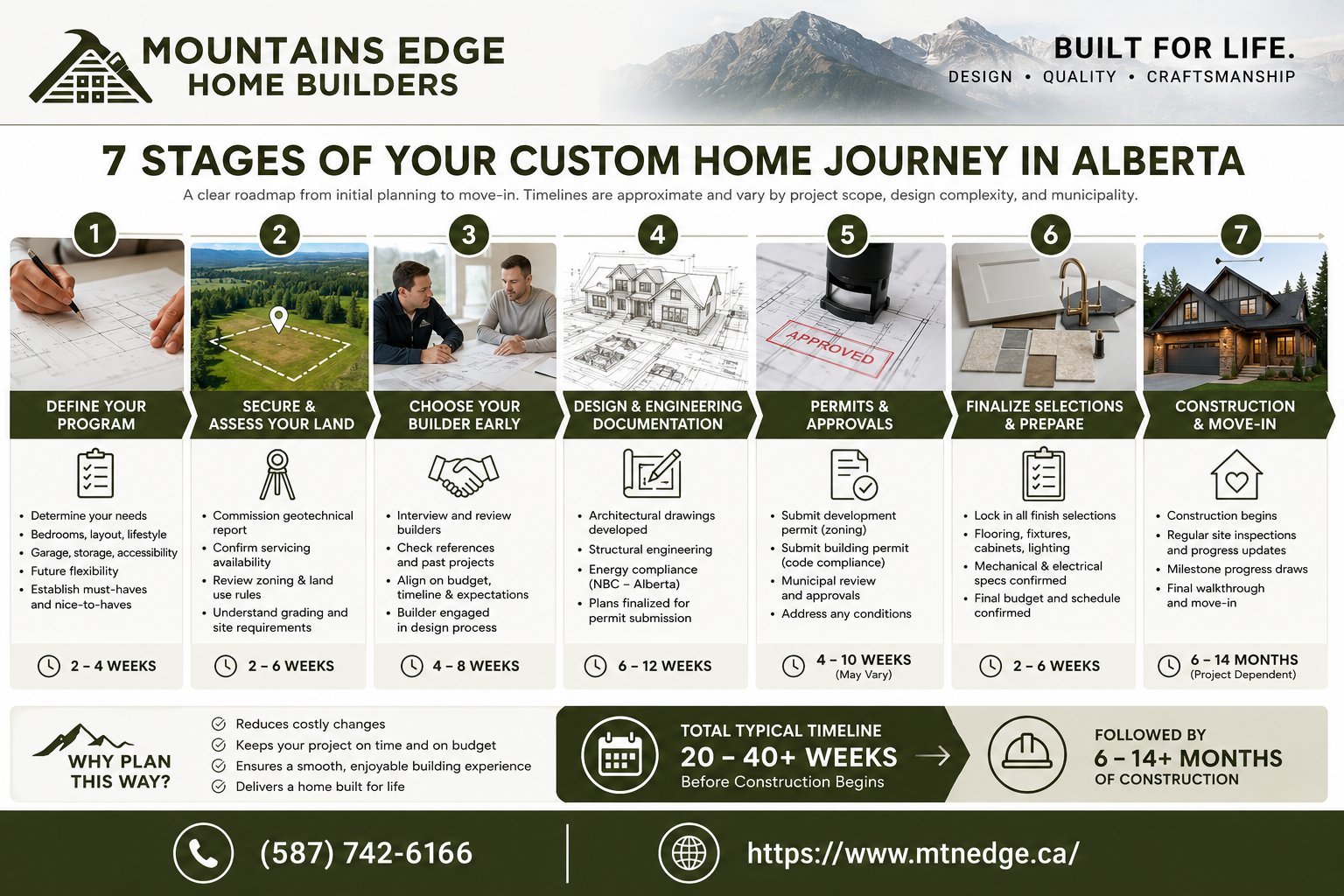
- Define your program before you design anything. A "program" in builder terms means the functional requirements of your home: number of bedrooms, how you use the main floor, garage needs, accessibility considerations, future flexibility. Getting this clear before design starts prevents expensive mid-process changes.
- Secure and assess your land. Before purchasing, commission a geotechnical report on the soil and confirm servicing availability. A lot that looks affordable can become expensive once you factor in utility connections, grading requirements, or poor soil bearing capacity.
- Choose a builder early in the process. In Alberta, experienced custom builders are often booked 12 to 18 months out. Engaging a builder during the design phase, rather than after, also means you get real cost input before plans are finalized. Reading through advice on choosing a custom home builder Alberta can help you structure that search.
- Commission architectural drawings and engineering. Your builder and designer will need stamped drawings for permit submission. In Alberta, this typically includes architectural plans, structural engineering, and energy compliance documentation under the National Building Code (NBC) as adopted provincially.
- Submit for development and building permits. Development permits address land use and zoning. Building permits address code compliance and construction specifics. These are separate applications in most Alberta municipalities and can run concurrently or sequentially depending on the jurisdiction.
- Finalize your selections before construction begins. One of the most common causes of cost overruns in custom builds is making finish selections during construction. Flooring, fixtures, cabinetry, and mechanical specs should be locked in before your builder mobilizes on site.
- Establish a communication and inspection schedule. Custom builds require regular site walks, progress draws tied to milestones, and structured communication with your builder. Agree on this framework at contract signing, not partway through the build.
How Long Does This Process Really Take?
In Alberta, the total timeline from initial planning to move-in for a custom home typically runs 18 to 30 months. The planning and permit phase alone takes 6 to 12 months for most projects, with construction running an additional 10 to 18 months depending on home size and complexity.
Alberta's winters compress the outdoor construction season. Framing, roofing, and foundation work are all weather-dependent, which means builds that start late in the calendar year may experience extended timelines. Builders who work year-round in Alberta have processes for winterized concrete pours and heated enclosures, but these add cost.
Permit timelines are genuinely unpredictable. Calgary and Edmonton have invested in permitting efficiency, but backlogs still occur during peak periods. Rural counties sometimes move faster on smaller builds but slower on anything requiring infrastructure review or subdivision approval.
Common Mistakes When Planning a Custom Home in Alberta
- Underestimating site development costs. A rural acreage can easily require $80,000 to $120,000 in site work before the house foundation is poured. Well drilling, septic systems, gravel driveways, electrical service connections, and grading are often treated as afterthoughts until the quotes arrive.
- Choosing a builder based on price alone. The lowest-bid builder on a custom project is rarely the lowest total cost by the end. Scope gaps, change order markups, and communication breakdowns during construction often make the cheaper option significantly more expensive. If you're evaluating high end home builder Alberta options, looking at portfolio consistency and past client references matters far more than the opening number.
- Locking in a design before confirming budget feasibility. Clients frequently spend months refining drawings only to discover the design costs 40 percent more to build than their budget allows. Getting a builder's preliminary cost estimate at the schematic design stage prevents this.
- Ignoring energy code requirements. Alberta adopted updated energy efficiency requirements that affect insulation levels, window performance ratings, and mechanical system specifications. Non-compliance delays permit issuance and can require costly redesigns.
- Not budgeting for temporary accommodations. If you're selling your current home to fund the build, coordinating the sale timeline with the construction schedule is complex. Most custom builds in Alberta require 10 to 18 months of construction time — plan your living situation accordingly.
- Making major changes after framing starts. Once walls are framed, moving a window or door costs significantly more than it would have at the design stage. Structural changes post-framing can run $5,000 to $20,000 for a single modification, depending on what's involved.

What to Look for in a Custom Home Plan
A strong set of construction drawings for an Alberta custom home isn't just a floor plan. By the time permit submission happens, your drawing package should include architectural drawings (floor plans, elevations, sections), structural engineering stamped by an Alberta-licensed engineer, energy compliance documentation, site plan with grading, and mechanical/electrical schematics if required by your municipality.
Incomplete permit packages are one of the leading causes of building permit delays in Alberta municipalities. Missing structural engineering, incomplete site plans, or energy compliance gaps can add 4 to 12 weeks to the permit review process, delaying construction start dates and compressing the build season.
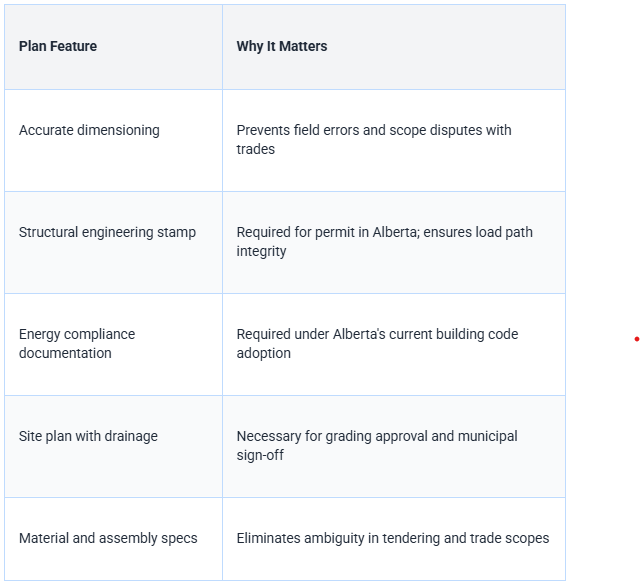
The five key features every construction plan should carry are: accurate dimensioning throughout, clearly specified materials and assemblies, structural load calculations, compliance notes referencing applicable Alberta Building Code sections, and a site plan showing setbacks, drainage flow, and utility locations. Plans missing any of these will be flagged during permit review.
Frequently Asked Questions
What are 5 key features of a construction plan?
A complete construction plan for an Alberta custom home includes accurate dimensioned floor plans and elevations, stamped structural engineering drawings, an energy compliance package meeting current code requirements, a site plan showing grading and setbacks, and detailed material and assembly specifications. Plans missing any of these typically face delays during municipal permit review. The more complete and coordinated the drawing set, the fewer field conflicts arise during construction.
What are the 7 steps in the building process?
The seven core stages are: land assessment and acquisition, design and drawing development, permit submission and approval, site preparation and foundation, framing and structural work, mechanical and envelope installation (plumbing, electrical, HVAC, insulation, windows), and interior finishing through to occupancy inspection. In Alberta, each stage has weather and seasonal timing considerations that affect scheduling. Builders experienced in Alberta's climate build these variables into their project timelines rather than treating them as exceptions.
How long does it take to build a home in Alberta?
From the start of planning to move-in, most custom homes in Alberta take 18 to 30 months. The permit and design phase alone typically runs 6 to 12 months, with construction taking 10 to 18 months depending on size and complexity. Weather interruptions, permit processing times, and trade availability all affect the schedule. Projects that begin in spring or early summer generally have the most efficient construction seasons without winter delays.
What is the most expensive part of building a house?
For most Alberta custom homes, the structural shell (foundation, framing, roofing, and exterior cladding) represents the largest cost category, often accounting for 25 to 35 percent of total construction costs. However, mechanical systems, including high-efficiency heating, in-floor radiant systems, HRV units, and plumbing rough-in, are frequently underestimated and can represent 15 to 20 percent of the total budget. Kitchens and primary bathrooms with custom cabinetry and premium fixtures are the highest per-square-foot finishing costs in most builds.
What decreases property value the most?
For custom homes in Alberta, the factors with the greatest negative impact on resale value are poor lot positioning (backing onto industrial land or major roadways), deferred maintenance on mechanical systems, low-quality exterior finishes that show age quickly, and floor plan inefficiency that doesn't suit the regional buyer profile. Oversized homes relative to neighbourhood comparables also suppress per-square-foot resale value. Building to a finish level that fits the local market, rather than significantly above or below it, consistently protects long-term value.
Making the Right Decision for Your Build
Planning a custom home in Alberta rewards people who do their homework early and stay organized through a process that has more moving parts than it first appears. The land, the builder, and the design decisions you make in the first few months set the trajectory for everything that follows. Changing course mid-build is always possible, but it's rarely affordable.
The homeowners who report the best experience consistently say the same things: they engaged their builder before finalizing their design, they built in a realistic contingency budget, and they chose a team that communicated proactively rather than reactively. Those aren't complicated insights, but they're genuinely the variables that separate smooth builds from stressful ones.
If you're at the early stages of planning, taking the time to understand what the process actually involves in Alberta, not just the general home-building process, gives you a meaningful advantage before any money changes hands.
Ready to Start Planning Your Custom Home?
Mountains Edge works with Alberta homeowners through every stage of the custom home planning process, from initial site assessment through to construction completion. If you're weighing your options or want to understand what a build like yours would realistically involve, the team is straightforward to talk to and won't push you toward decisions before you're ready.
Reach out to Mountains Edge at (587) 742-6166 to have a conversation about your project. Whether you're 6 months from breaking ground or still exploring whether a custom build is the right path, getting informed early makes every step after it easier.