Homes built for Alberta's climate require specific design choices that address extreme cold, heavy snowfall, hailstorms, and dramatic seasonal temperature swings. From foundation depth and insulation ratings to roofing materials and heating systems, every structural decision has to account for conditions that most Canadian building codes treat as edge cases. Getting these details right from the start is the difference between a home that performs for decades and one that demands constant repairs.
Alberta's weather doesn't follow a polite script. A chinook can push temperatures from -30°C to +15°C within hours. Summer hailstorms routinely damage roofs and siding across Calgary and the surrounding foothills. Spring snowmelt can saturate foundations that weren't properly waterproofed. If your home wasn't designed with these realities in mind, you're not just uncomfortable; you're paying for it every season.
Key Takeaways
- Alberta's climate demands insulation values, foundation depths, and roofing materials that exceed standard Canadian building minimums.
- Thermal bridging, air sealing, and vapour barriers are the three most overlooked contributors to heat loss in Alberta homes.
- Impact-resistant roofing rated Class 4 is the most effective defence against Alberta hailstorms and can reduce insurance premiums.
- Heating system selection matters as much as insulation — hydronic radiant systems and high-efficiency furnaces perform very differently in extended cold snaps.
- Proper grading, drainage, and foundation waterproofing are non-negotiable in regions with significant spring snowmelt.
- Working with a builder who understands Alberta-specific conditions, rather than a generic national builder, dramatically reduces long-term maintenance costs.

Why Alberta's Climate Demands More Than Standard Construction
Most building codes across Canada set minimums. In Alberta, those minimums are often not enough. The province sits in a continental climate zone where temperatures regularly drop below -30°C in winter and spike above 30°C in summer. That 60-degree seasonal range creates enormous stress on every component of a home's envelope, from the foundation to the ridge cap.
The foothills and mountain-adjacent regions add another layer of complexity. Wind-driven snow, rapid chinook warming cycles, and elevated hail frequency make these areas particularly demanding on roofing and cladding systems. Builders who are experienced with foothills custom homes in Alberta understand these regional pressures and plan for them at the design stage, not after problems surface.
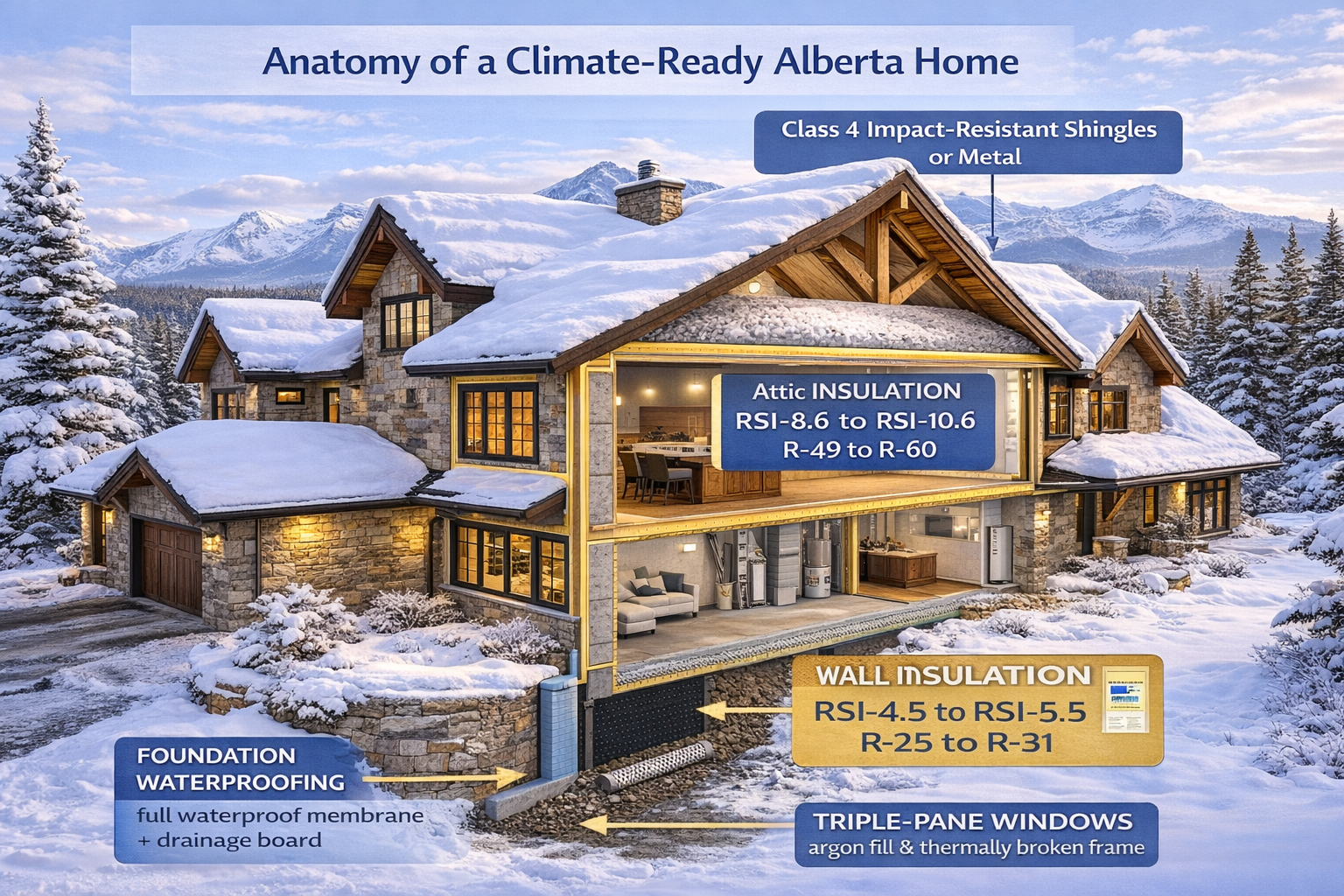
Alberta's building code requires a minimum RSI-5.02 (approximately R-28.5) for attic insulation in Climate Zone 7, but energy efficiency experts frequently recommend RSI-8.6 to RSI-10.6 (R-49 to R-60) for homes in colder zones of the province, particularly those north of Edmonton or at higher elevations near the Rockies.
The cost of under-insulating isn't just a heating bill problem. It accelerates ice dam formation, increases humidity differentials that drive mould risk, and shortens the service life of mechanical systems that have to work harder to compensate. Proper performance starts with proper specification.
What Makes a Home Truly Climate-Ready in Alberta?
Climate-readiness isn't a single feature. It's a layered system where each component reinforces the others. A well-insulated home with poor air sealing still bleeds heat. A strong roof with inadequate drainage still creates foundation risk. Understanding how these systems interact is what separates a well-built Alberta home from one that's merely code-compliant.

Step-by-Step: How Climate-Resilient Homes Are Designed and Built in Alberta
- Climate zone assessment: Identify which of Alberta's climate zones the build site falls within — northern Alberta (Zone 7B), the Edmonton corridor (Zone 7A), and Calgary or the foothills (Zone 6/7) each have different thermal and moisture requirements that drive all downstream design decisions.
- Foundation specification: Determine frost depth for the site (typically 1.2m to 1.8m in most of Alberta) and specify foundation insulation, drainage tile, and waterproofing accordingly. This is where most budget-focused builders cut corners with lasting consequences.
- Envelope design: Design the wall assembly, roof assembly, and window package as a system. Using a design build approach in Alberta helps align structural decisions with energy performance targets from the start rather than retrofitting them later.
- Mechanical system selection: Choose a heating system suited to the design's performance level. High-performance envelopes can support smaller heating equipment, which reduces both capital cost and long-term operating expense.
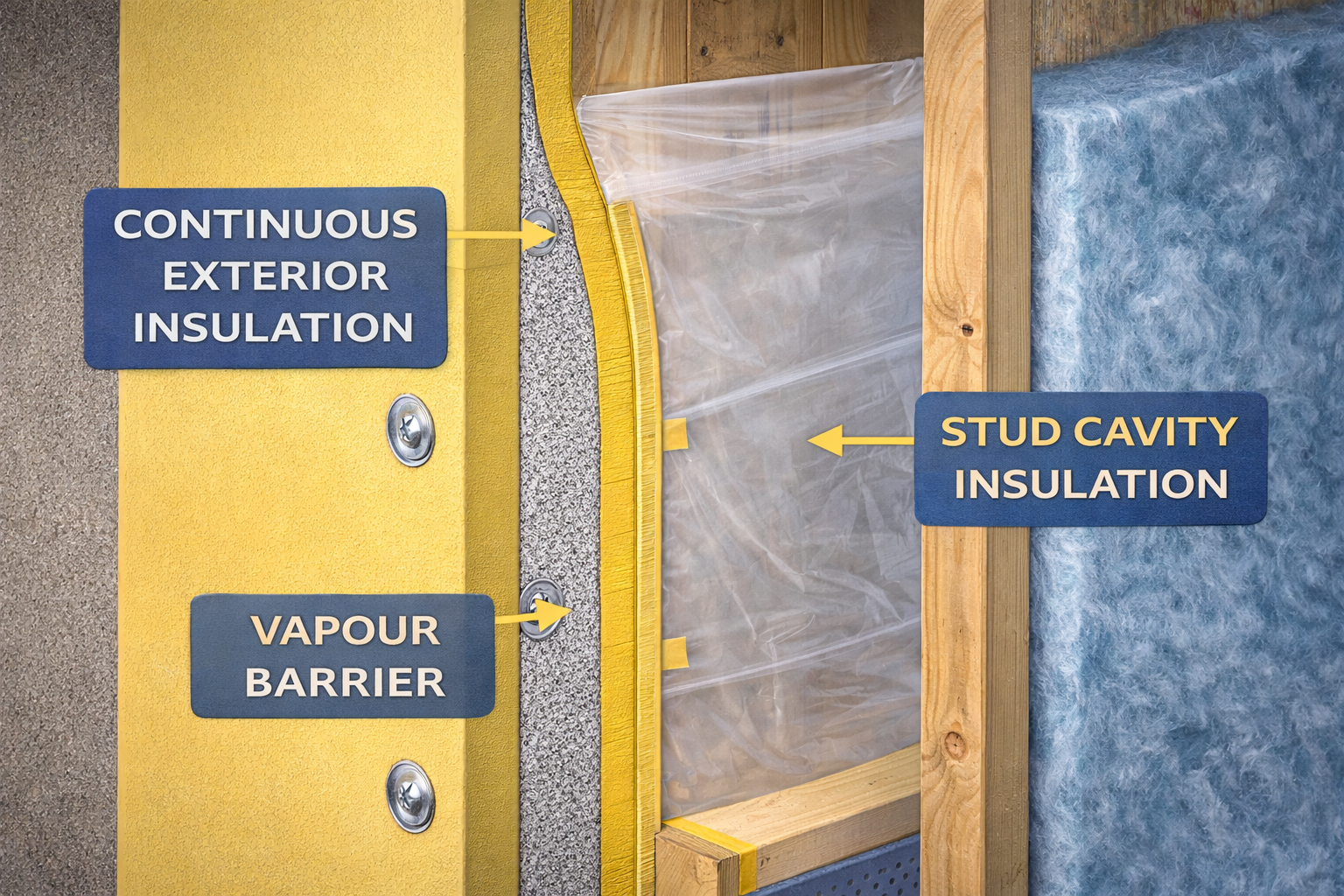
- Air sealing and vapour management: Complete all air sealing before drywall and conduct a blower door test to confirm airtightness targets are met. This step is skipped on a surprising number of new builds and is one of the primary reasons homes underperform their energy ratings.
- Roofing and cladding for hail resilience: Specify Class 4 impact-resistant shingles or metal roofing and select cladding rated for impact resistance. This is non-negotiable in hail-prone areas from Calgary south through Lethbridge.
- Site drainage and grading: Grade the lot to direct water away from the foundation and install a sump pump system where soil conditions warrant. Spring snowmelt is one of the leading causes of basement flooding in Alberta.
How Much Does It Cost to Build a Climate-Ready Home in Alberta?
Custom home construction in Alberta currently ranges from approximately $350 to $600 per square foot for a well-specified build, with high-performance and luxury builds reaching $700 to $900 per square foot or more depending on location, finishes, and site conditions. The premium for climate-specific upgrades like triple-pane windows, continuous insulation, and Class 4 roofing typically adds 5% to 12% to the base construction budget.
That upfront investment in climate-appropriate materials tends to pay back through reduced heating and cooling costs, lower insurance premiums (particularly for hail-resistant roofing), and avoided repair costs over a 20- to 30-year ownership horizon. If you're evaluating the full picture, reviewing what goes into the cost to build a custom home in Alberta helps frame where the value-adding upgrades sit relative to total project cost.
Homeowners with Class 4 impact-resistant roofing in Alberta can receive insurance premium discounts of 20% to 35% depending on their insurer and location. In high-hail-frequency areas like Calgary, Airdrie, and Okotoks, these discounts can represent thousands of dollars in annual savings over the life of the roof.
Common Mistakes When Building Homes in Alberta's Climate
- Treating code minimum as a performance target. Alberta's building code sets a legal floor, not an optimal specification. Homes built exactly to minimum often struggle with condensation, high heating bills, and premature envelope failures.
- Ignoring thermal bridging. Studs, headers, and rim joists conduct heat far more efficiently than insulation. Without continuous exterior insulation to address bridging, even high-RSI walls underperform their nominal ratings significantly.
- Skipping the blower door test. Air leakage accounts for a substantial portion of heat loss in cold climates. Without testing, there's no way to know whether the air barrier installation was successful.
- Choosing standard asphalt shingles in hail zones. Basic 3-tab or even standard architectural shingles frequently require full replacement after a major hail event. The upgrade cost to Class 4 is modest relative to the risk.
- Underspecifying the foundation drainage system. Many builders install dampproofing where waterproofing is warranted, particularly in areas with clay-heavy soils that hold moisture seasonally.
- Oversizing heating equipment. A common instinct is to install a larger furnace "just in case." In a well-sealed, well-insulated home, an oversized furnace short-cycles, reduces efficiency, and wears out faster than properly sized equipment.
Areas in Alberta Where Climate-Specific Building Is Most Critical
While every part of Alberta benefits from climate-conscious construction, certain regions face compounding challenges that make careful specification especially important.

Working with a builder who has hands-on experience in your specific region matters. A builder familiar with foothills wind loads approaches framing and cladding differently than one who primarily builds in sheltered urban lots. If you're in the process of evaluating options, understanding what to look for when choosing a custom home builder in Alberta can help you ask the right questions early.
Frequently Asked Questions
What is a "Climate-Ready" home in Alberta?
A climate-ready home in Alberta is one designed and built to handle the province's full range of environmental stresses: extreme cold winters, high hail frequency, rapid temperature swings driven by chinooks, heavy snow loads, and spring flooding risk. It goes beyond meeting building code minimums and instead specifies insulation, roofing, foundation, and mechanical systems that perform reliably across all of those conditions without constant intervention or repair.
How do I protect my home against Alberta hail?
The most effective protection is installing Class 4 impact-resistant roofing, which is the highest rating under the UL 2218 standard and is specifically tested against golf ball-sized hail impacts. Pair that with impact-rated siding materials such as fibre cement or engineered wood cladding. Many insurers in Calgary and southern Alberta offer significant premium discounts for verified Class 4 roofing installation. Skylights should use tempered or laminated glass rated for impact resistance.
What heating system is best for cold climates?
For Alberta's climate, high-efficiency gas furnaces (AFUE 96% or higher) paired with a heat recovery ventilator (HRV) remain the most common and cost-effective choice for most builds. Hydronic radiant floor heating offers superior comfort and even heat distribution, particularly in slab-on-grade or basement areas. In very high-performance, well-sealed homes, air source heat pumps with a gas backup are gaining traction, though their performance in extended sub-30°C conditions should be carefully evaluated for northern Alberta sites.
How do I prevent my home from flooding?
Foundation waterproofing, proper lot grading, perimeter drainage tile, and a sump pump system are the core defences against flooding from snowmelt and groundwater. The lot should be graded to slope away from the foundation at a minimum 5% grade for at least 1.8 metres. Window wells need dedicated drainage, and downspouts should discharge water at least 1.8 metres from the foundation. In areas with clay-heavy soils or high water tables, a backup sump pump with battery power is a worthwhile addition.
What are the key construction materials needed for Alberta?
For Alberta's climate, prioritise Class 4 impact-resistant roofing shingles or metal roofing, fibre cement or engineered wood cladding over vinyl, triple-pane argon-filled windows with thermally broken frames, continuous exterior insulation to address thermal bridging, a full waterproofing membrane rather than dampproofing on foundation walls, and framing lumber sized and spaced to accommodate the required insulation thickness without compromising structural integrity. These aren't luxury upgrades; for Alberta conditions, they're the baseline for a durable build.
Building Right the First Time Matters More in Alberta Than Almost Anywhere
The consequences of cutting corners on climate-appropriate construction show up faster and cost more in Alberta than in more temperate provinces. A roof that might last 25 years in Vancouver might see hail damage within five years outside Calgary. A foundation that's merely dampproofed might be dry in Kelowna and flooded in Airdrie. The climate here is specific, and your home needs to be built for it specifically.
For those building in the foothills or anywhere across Alberta, working with an experienced, Alberta-focused builder is the single most impactful decision in the process. The team at Mountains Edge, a high end home builder in Alberta, designs and builds homes with the province's specific climate demands integrated from the first design conversation, not added as afterthoughts during framing.
Studies on building envelope performance in Canadian cold climates have consistently shown that homes built to exceed code minimums by 20 to 30% in insulation and airtightness demonstrate 30 to 50% lower annual heating energy consumption compared to code-minimum builds, with the payback period for the additional investment typically falling between 8 and 14 years depending on natural gas pricing and climate zone.
If you're planning a new home build in Alberta and want it done right for the climate you're actually building in, reach out to Mountains Edge. Call (587) 742-6166 to talk through your project with a team that understands what Alberta weather demands of a home built to last.