Building a custom home in Alberta typically takes 12 to 24 months from initial design to move-in, depending on project complexity, municipality permitting timelines, and seasonal construction windows. Most builds follow a predictable sequence of planning, permitting, foundation work, framing, and interior finishing, but delays commonly occur during the permit approval stage and in trades scheduling during peak building seasons.
If you've started researching what it actually takes to build a custom home in Alberta, you've probably noticed that most answers range from vague to wildly optimistic. The truth is more nuanced, and understanding the real phases involved will help you plan a build that doesn't unravel the moment winter hits or your permit application sits in a municipal queue for three months.
Key Takeaways
- Most custom home builds in Alberta take 12 to 24 months from design to occupancy, with complex or acreage builds trending toward the longer end.
- The permitting phase is frequently the most overlooked source of delay, adding 2 to 6 months to the timeline in many municipalities.
- Alberta's climate creates hard constraints on concrete and exterior work, with optimal construction windows running from May through October.
- Trades availability, particularly for electrical and HVAC, is one of the most variable and underestimated factors in actual build duration.
- Decisions made late in the process, like changing finishes after drywall is ordered, can push completion dates by weeks or more.
- Working with an experienced local builder from day one compresses timelines significantly by front-loading planning decisions.

What Does a Realistic Custom Home Timeline in Alberta Look Like?
Most builders quote a general range, but the gap between a 12-month build and a 24-month build is not random. It comes down to how much pre-planning happened before a shovel touched the ground, and how prepared the homeowner was during decision-making phases.
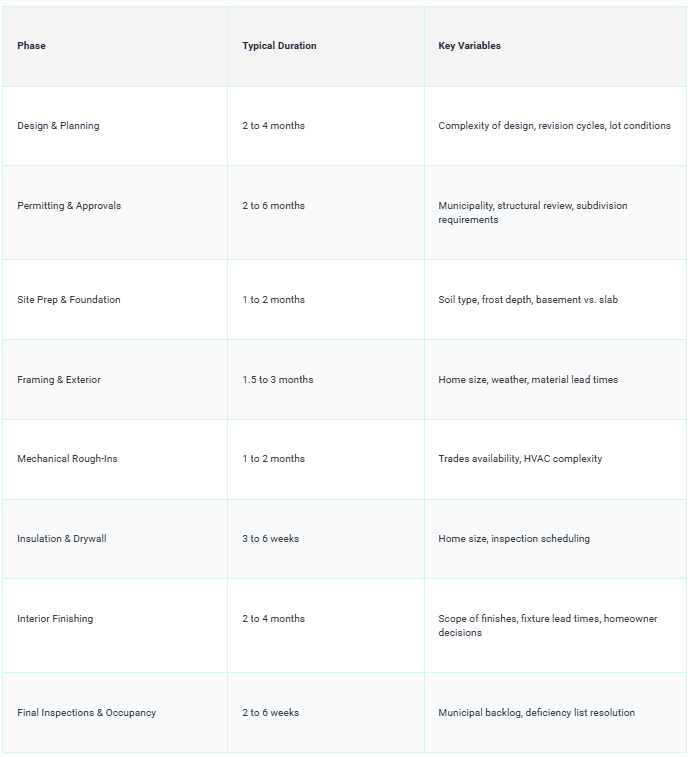
Here is a realistic phase-by-phase breakdown that reflects what actually happens on Alberta custom builds, not the ideal scenario.
Custom home builds in Alberta take an average of 14 to 18 months for a standard single-family detached home on a serviced lot. Acreage builds, which require well, septic, and potentially private road access, frequently add 3 to 6 months to that baseline. Luxury or architecturally complex homes can push timelines to 24 months or beyond.
How Does Alberta's Climate Affect the Build Schedule?
This is where Alberta builds differ meaningfully from builds in milder climates. Concrete pours, which cover your foundation, flatwork, and some exterior elements, require temperatures above +5°C to cure properly. In practice, this means experienced Alberta builders treat the May to October window as the primary construction season for ground-up work.
In Alberta, ground frost can penetrate to depths of 1.5 to 2.4 metres in colder regions, which means excavation timing directly impacts foundation scheduling. Builders who break ground in September or October risk hitting frozen subsoil conditions by late October or November, which can halt excavation or significantly increase cost if heated enclosures are required for concrete work.
That said, indoor work continues year-round. Framing, mechanical rough-ins, insulation, and interior finishing are all viable during Alberta winters, which is why builders who manage their sequencing well can maintain productivity through colder months. The key is to have the building envelope fully closed before the cold sets in.

Step-by-Step: The Custom Home Build Process in Alberta
- Lot acquisition and site assessment — Before any design work begins, understanding the lot's soil conditions, utility connections, and municipal zoning requirements prevents expensive redesigns later. An acreage lot often requires a geotechnical report before a builder can even propose a foundation type.
- Design and architectural planning — Working with your builder and designer simultaneously, rather than sequentially, compresses this phase. Decisions about structural systems, ceiling heights, and mechanical layout need to happen here, not during rough-in. If you're planning a custom home, front-loading these decisions pays dividends throughout the entire build.
- Permit application submission — Submit to your municipality once drawings are complete and stamped by an engineer. In areas like Rocky View County or Wheatland County, rural applications may involve additional provincial reviews.
- Site preparation and excavation — Includes stripping topsoil, excavating for the basement or crawlspace, and establishing rough grading. This phase moves quickly, typically within a few weeks, but is highly weather-dependent.
- Foundation pour and cure — Concrete requires adequate cure time before backfilling. Rushing this stage creates structural risk that shows up years later in cracking and moisture issues.
- Framing — Once the foundation is backfilled and inspected, framing begins. This is the fastest-moving phase visually and often what homeowners find most exciting, as the home takes shape in a matter of weeks.
- Mechanical rough-ins — Plumbing, electrical, and HVAC work happens inside the open wall cavities before insulation. Trades must be scheduled in a specific sequence, and delays from one trade cascade into the next.
- Insulation, vapour barrier, and drywall — This phase gets inspected before drywall is hung. Getting that inspection scheduled promptly matters, as some municipalities have backlogs of 2 to 4 weeks for mid-construction inspections.
- Interior finishing — Flooring, cabinetry, trim, painting, fixture installation, and tile work happen here. This is also where homeowner-driven decisions have the biggest timeline impact.
- Final inspection and occupancy permit — Your municipality conducts a final inspection, issues deficiencies if applicable, and ultimately grants occupancy. You cannot legally move in before this is issued.
Why Does the Permitting Stage Take So Long?
Permit processing times vary significantly across Alberta municipalities. Calgary's building department has published service standards targeting 8 to 12 weeks for single-family residential permits, but during peak application periods this has historically stretched longer. Smaller municipalities like Lacombe or Okotoks may process permits faster due to lower application volumes, while rural counties involving both municipal and provincial approvals can extend timelines to 4 to 6 months.
What most homeowners don't account for is that permit approvals are rarely a single-step process. An initial submission might come back with requests for engineering revisions, updated site plans, or energy efficiency compliance documentation. Each revision cycle adds weeks. Working with a builder who has a strong local permitting history, and who submits complete packages the first time, makes a measurable difference.
If you're evaluating builders, ask them directly about their permit approval track record and what their average permitting timeline has been in the municipality where you plan to build. That question alone separates experienced operators from newer entrants. Understanding the full cost picture starts with choosing wisely; you can review a detailed breakdown of what it costs to cost to build a custom home in Alberta before committing to any phase.
What Are the Most Common Mistakes That Delay Custom Home Builds?
- Changing selections after ordering: Swapping countertop materials or cabinet styles after the order is placed can delay delivery by 6 to 12 weeks and throw off the entire interior finishing schedule.
- Choosing a builder based on price alone: A lower bid often reflects thinner trade relationships or less experience managing schedules, both of which add time, not save it. If you're still deciding, understanding what to look for when choosing a custom home builder is worth the research time.
- Skipping or delaying the geotechnical assessment: On acreage lots especially, not knowing soil bearing capacity before design starts can force structural redesigns mid-permit, a costly and time-consuming problem.
- Underestimating trades lead times: Speciality trades like custom metal staircases, heated driveway systems, or specific tile setters often require booking 3 to 4 months in advance. Missing that window pushes completion out.
- Starting construction before finalizing the design: Homeowners who begin framing before all design decisions are locked in consistently experience scope changes that require tear-out and rework.
- Not accounting for municipal inspection wait times: Many homeowners plan their move-in date around construction completion, not realising that final inspections and occupancy permits can add 3 to 6 weeks at the end.

How Do Build Times Compare by Home Type and Location?

Builders operating in mountain-adjacent communities like Cochrane, Bragg Creek, or the Canmore corridor face additional complexity due to stricter architectural controls, slope stability requirements, and in some cases, environmental setback rules that require additional engineering documentation before permit approval. These factors routinely add 2 to 4 months to the pre-construction phase compared to urban or flat rural builds.
For homeowners considering a high end home builder in Alberta, it's worth understanding that longer timelines on luxury builds are not a sign of inefficiency. They reflect the complexity of managing custom millwork, imported fixtures, specialty trades, and the level of coordination that high-specification builds genuinely require.
Frequently Asked Questions
What factors cause delays in building a custom home?
The most common sources of delay in Alberta custom home builds are permit approval backlogs, late homeowner decisions on finishes and fixtures, trades scheduling conflicts, and weather interruptions to exterior work. Material lead times for custom items like cabinetry or specialty windows can also add weeks to the finishing phase if not ordered early enough.
Is it faster to build in summer or winter in Alberta?
Starting in spring gives you the best chance of completing exterior and foundation work before freeze-up, which is the most significant seasonal advantage. Interior finishing work can proceed through winter without meaningful slowdown, so winter is not a dead period. The real risk is beginning excavation or foundation work too late in the fall and having weather halt progress mid-foundation.
What is the most time-consuming stage of the build?
Interior finishing is typically the longest single phase, spanning anywhere from 2 to 4 months depending on the scope of work. However, if you include the pre-construction period, permitting consistently adds the most uncontrollable delay. It's the phase with the least builder control and the most variability based on municipal capacity.
How long does the permitting process take?
In Alberta, permit timelines vary by municipality. Urban centres like Calgary target 8 to 12 weeks for standard residential permits, though complex applications with structural reviews can take longer. Rural county applications involving both municipal and provincial environmental reviews can take 4 to 6 months. Submitting a complete, engineer-stamped package on the first attempt is the single most effective way to minimise permit delays.
How can I speed up my custom home project?
The most impactful things homeowners can do are: finalize all design decisions before construction begins, pre-order long-lead items like windows, cabinetry, and appliances early, and choose a builder with established trade relationships and a strong local permitting track record. Avoiding mid-construction changes is also critical, as even minor scope shifts during framing or finishing can cascade into significant schedule slippage.
Ready to Start Your Custom Home Build in Alberta?
Understanding the timeline is the first step to managing a custom home build with confidence rather than frustration. Most delays are preventable with the right planning, the right builder, and a clear-eyed view of what each phase actually involves.
Mountains Edge works with homeowners across Alberta who want a build process that's transparent, well-managed, and built around their specific site and goals. From the first design conversation through final occupancy, the focus is on keeping your project on schedule without cutting corners on quality.
If you're ready to talk about your build, call Mountains Edge at (587) 742-6166 to connect with someone who can give you a realistic timeline and process overview for your specific project. No pressure, just honest information to help you plan well.