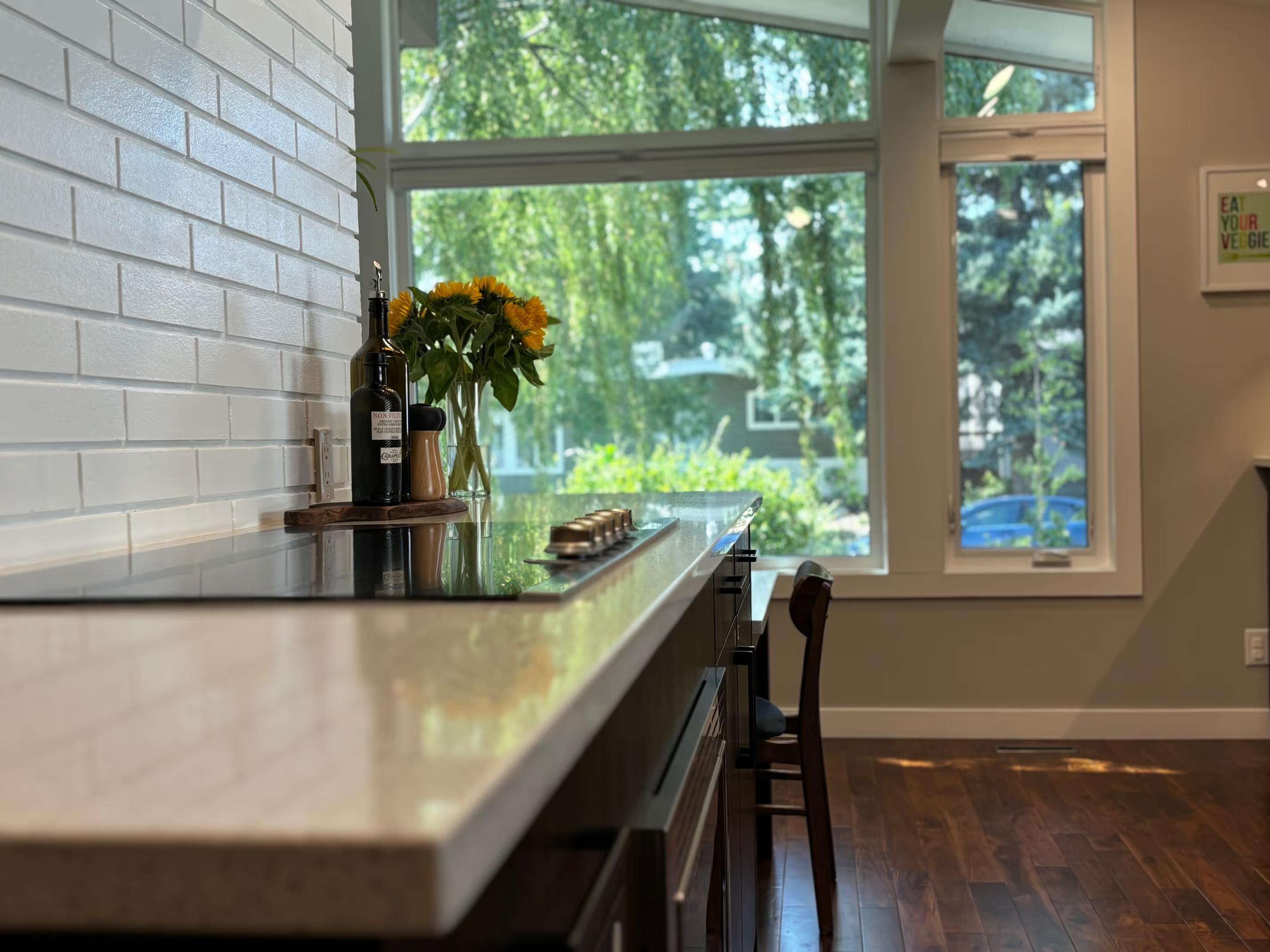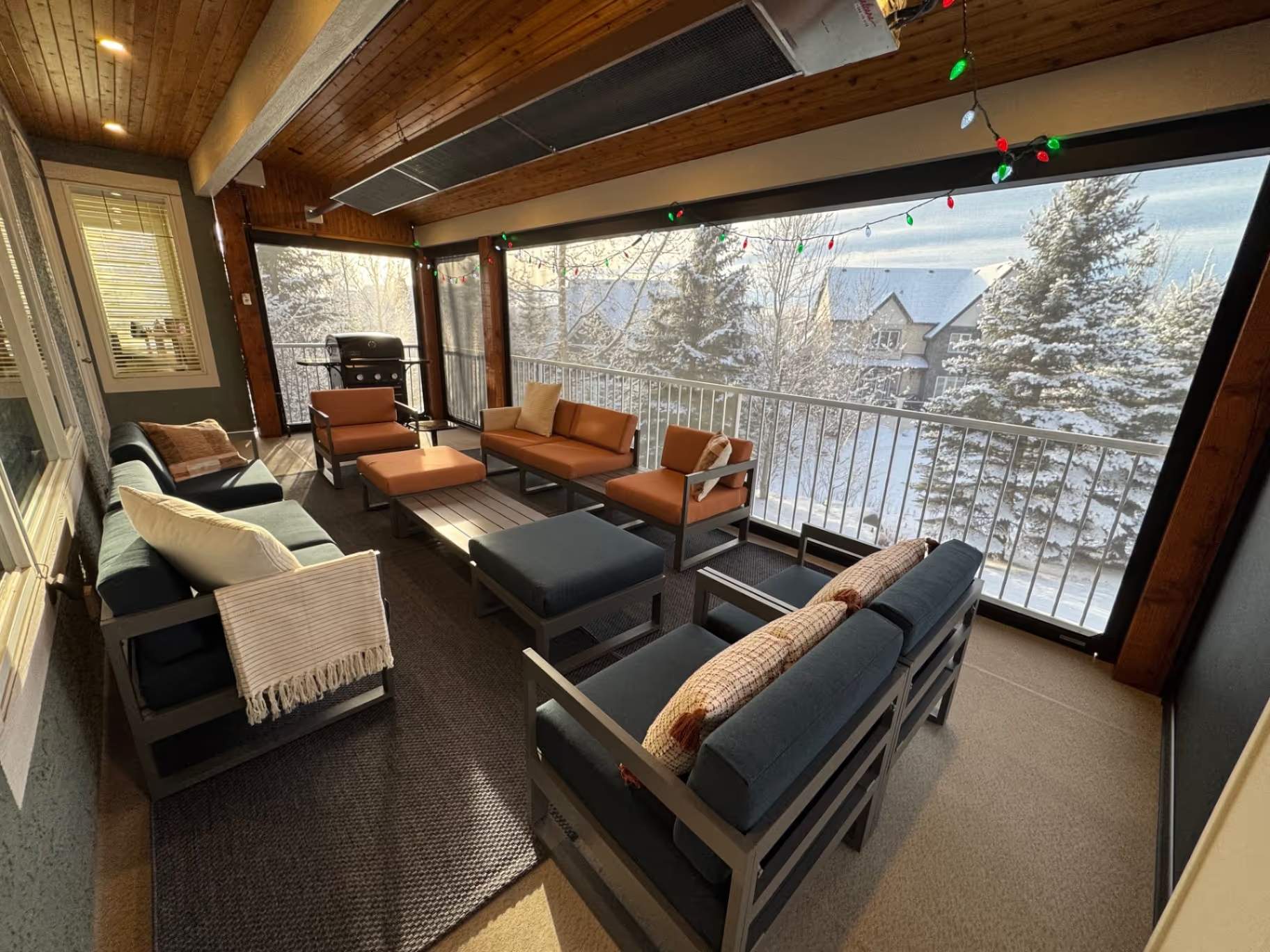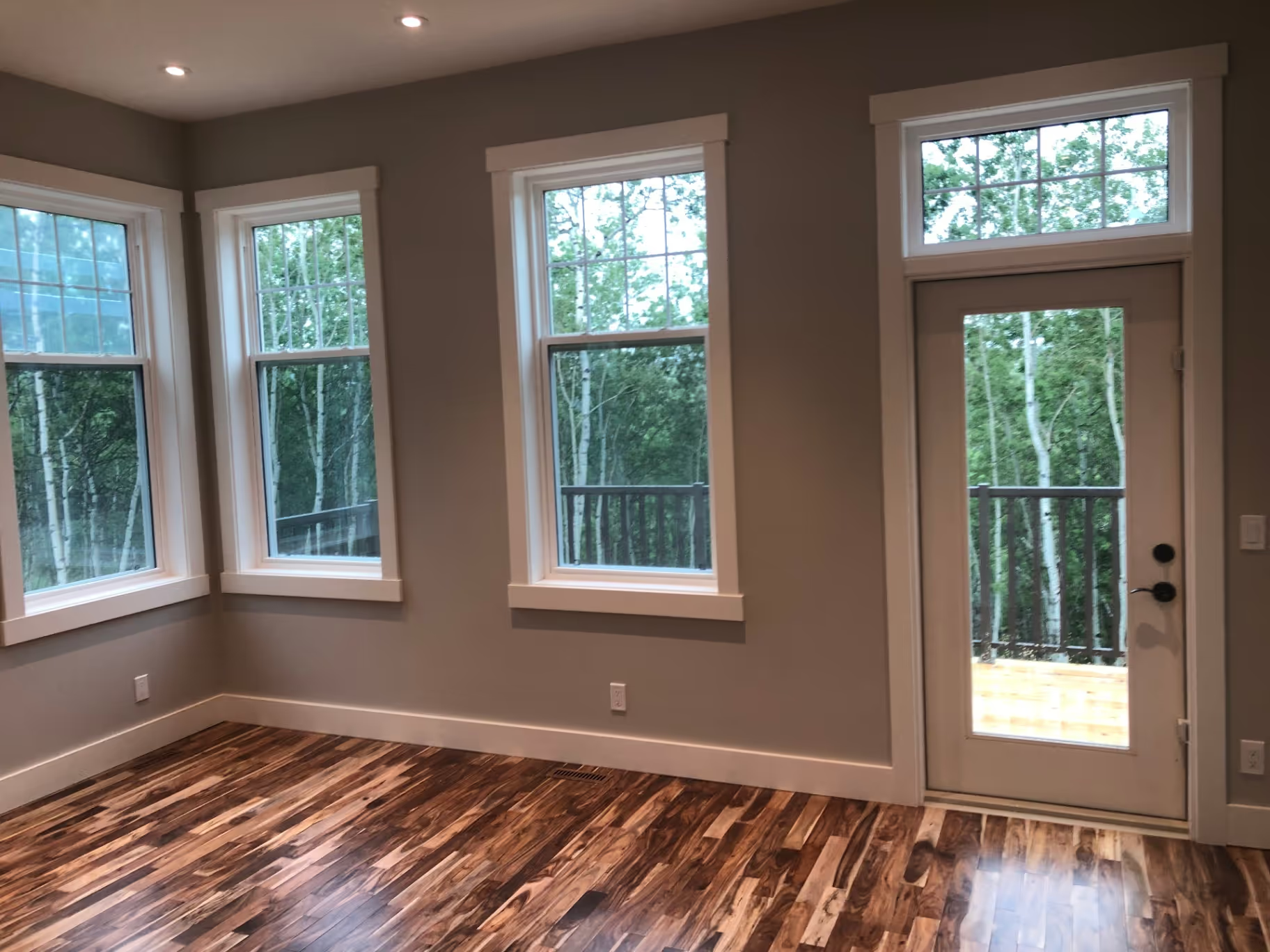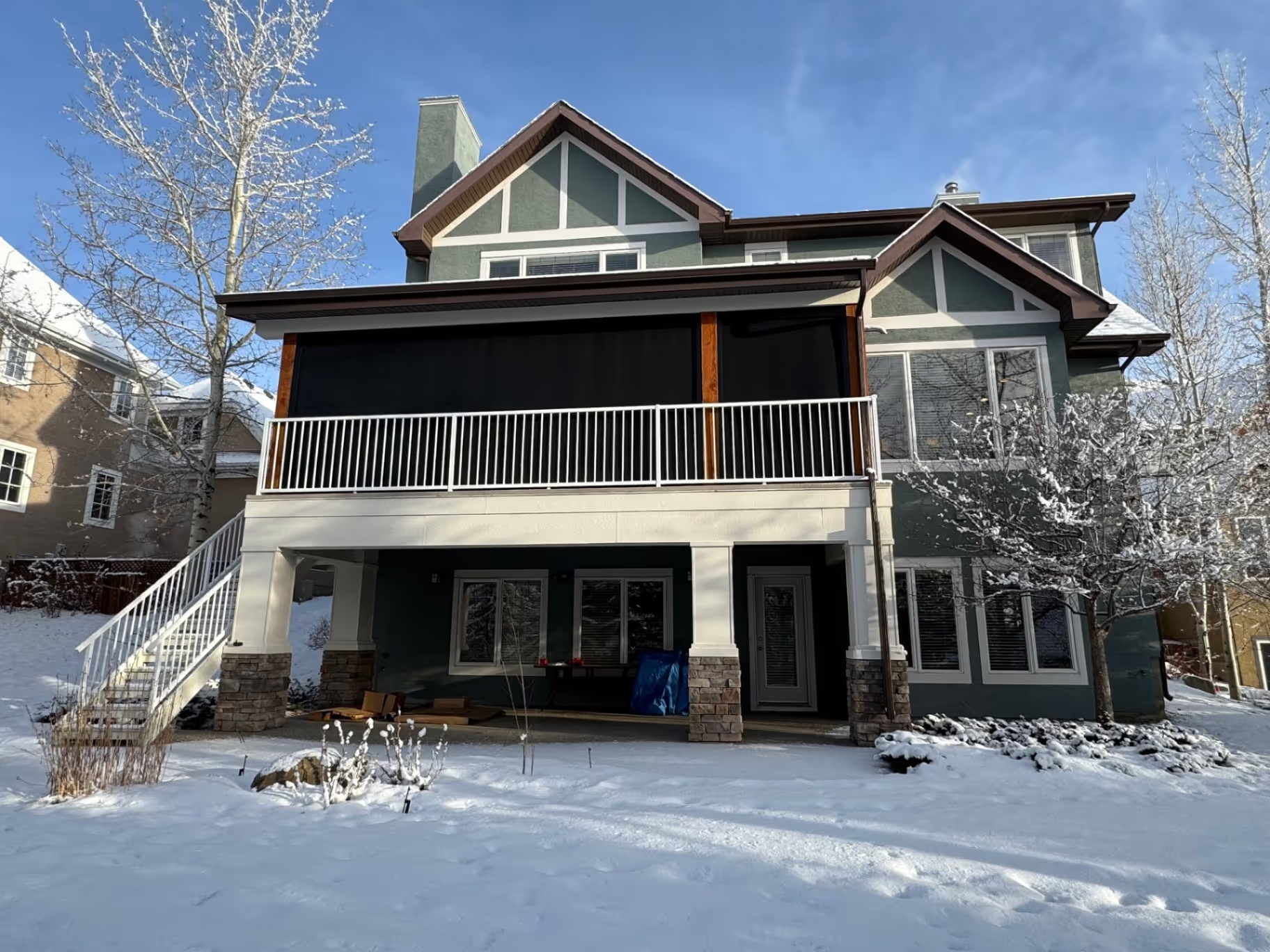
A whole home renovation in Alberta involves far more than cosmetic updates. From municipal permits and structural changes to managing trades across multiple phases, homeowners in Rocky View County, Foothills County, and greater Calgary need a clear plan before breaking ground. Working with an experienced design-build team simplifies the process and protects the investment at every stage.
Introduction
Most homeowners considering a whole home renovation already know their house needs serious work. What they underestimate is how much planning, coordination, and decision-making happens before a single wall comes down.
This guide walks through the full picture: what a complete home renovation actually involves, what drives costs in Alberta, how permitting works, and what separates a smooth project from a costly one. If you're weighing whether to renovate or rebuild entirely, you'll find practical guidance here for that too.
Key Takeaways
- A whole home renovation in Alberta typically involves structural, mechanical, and cosmetic work across every major area of the house, not just surface finishes.
- Permits are required for most structural, electrical, plumbing, and HVAC changes, and skipping them creates serious liability issues when it comes time to sell.
- Rural properties in Rocky View County and Foothills County have unique considerations including well systems, septic, and access logistics that affect both cost and scheduling.
- The design-build model, where one team handles both design and construction, reduces communication gaps and keeps the project on a single accountable timeline.
- Homeowners who try to manage multiple independent trades without a general contractor or design-build firm often experience significant delays and budget overruns.
- For older homes requiring extensive reconfiguration, a full rebuild is sometimes the more cost-effective path and worth comparing against a major renovation.
Things You Must Know
1. Scope Creep Is the Most Common Reason Renovations Go Over Budget Once walls open up, unexpected conditions are common: outdated wiring, undersized structural members, moisture damage, or plumbing that doesn't meet current code. In older Alberta homes, especially those built before the 1990s, these discoveries aren't rare exceptions. A contingency budget of 15 to 20 percent on top of your main renovation budget is a reasonable planning assumption, not a pessimistic one. A professional pre-renovation assessment can identify some of these risks before work begins.
2. Not Every Builder Is Set Up for Whole Home Projects Whole home renovations require a general contractor who can coordinate multiple trades simultaneously and sequence them correctly. Hiring individual trades independently without that coordination layer creates scheduling conflicts, accountability gaps, and quality control issues. Before hiring anyone, ask specifically how they manage multi-trade sequencing and what their process looks like when unexpected structural conditions arise mid-project.
3. Rural Properties Require Additional Planning That City Renovations
If your property is on an acreage in Rocky View County or Foothills County, your renovation planning needs to account for well and septic system condition, site access for large equipment, and in some cases, propane or alternative energy systems. These factors affect both the timeline and the contractor's familiarity with the project. Not all renovation companies are experienced with rural residential builds, and choosing one that is can make a significant difference in how smoothly things go.
What Does a Whole Home Renovation Actually Include?
The term gets used loosely, but a true whole home renovation means every major system and living area of the house is addressed in a coordinated project. That's different from doing a kitchen one year, bathrooms the next, and painting the year after. A complete renovation tackles everything as one integrated scope of work.
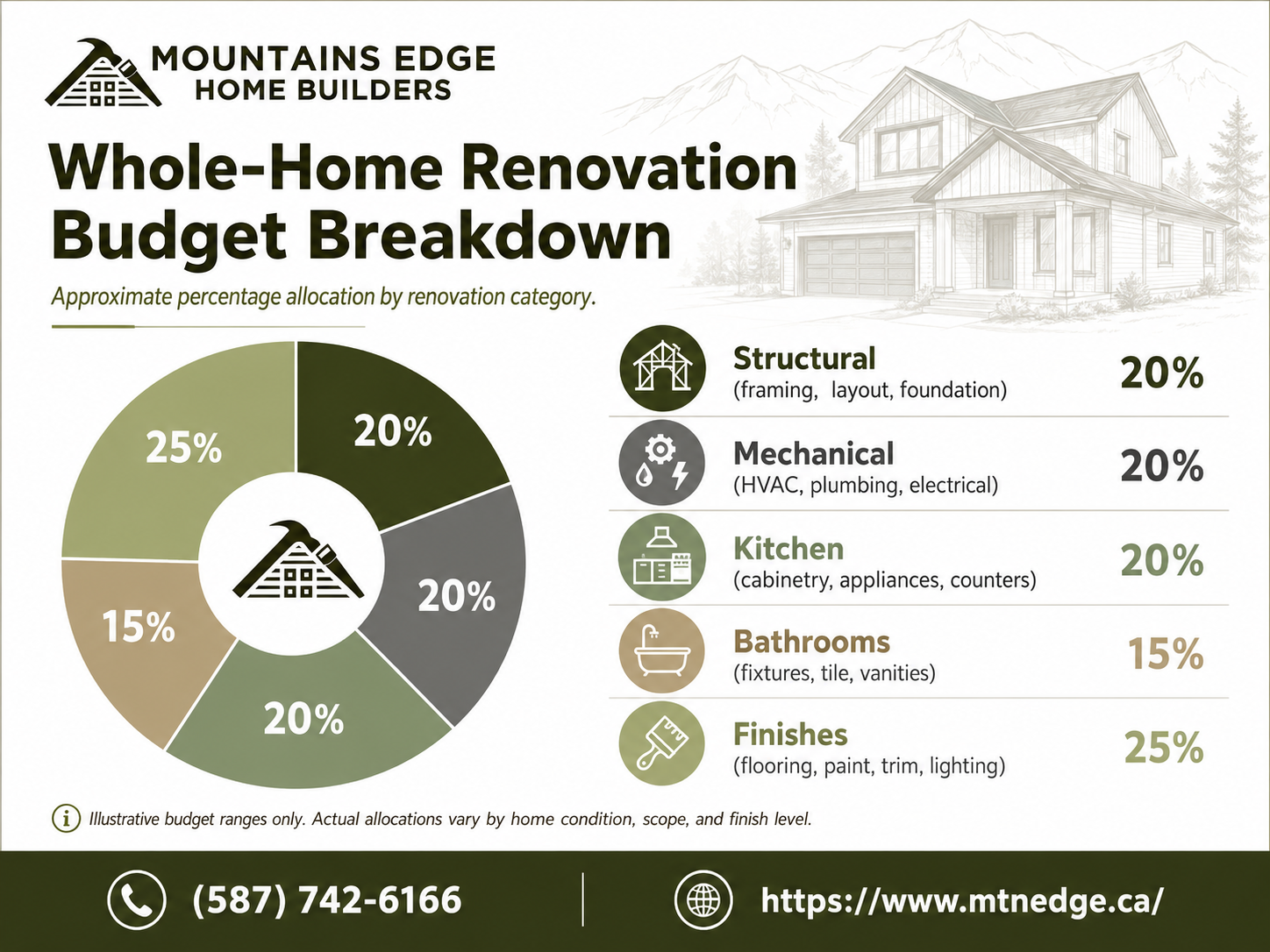
Depending on the home's condition and the homeowner's goals, this typically includes some combination of the following areas.
What Drives the Cost of a Whole Home Renovation in Alberta?
Project cost depends on the home's size, age, current condition, the extent of structural changes, and the quality of finishes selected. There's no flat-per-square-foot number that applies universally because two homes of identical size can have completely different renovation scopes.
Whole home renovations in Alberta commonly range from $150,000 to $500,000 or more depending on scope, finishes, and property characteristics. Projects involving major structural reconfiguration, full mechanical system replacement, and high-end finishes throughout are more likely to sit at the upper end of this range. Properties in rural areas may also face higher costs due to site access and trade availability.
The factors that most consistently push costs higher include:
- Removing or relocating load-bearing walls, which requires engineering review and structural work
- Upgrading aging electrical panels to meet current code (especially common in homes built before 1990)
- Replacing original plumbing, particularly in homes with galvanized steel or older copper systems
- Selecting custom cabinetry, stone countertops, and imported tile rather than builder-grade materials
- Site-specific challenges on rural properties, including limited contractor access and longer material delivery times
Whole Home Renovation vs. Rebuilding: How Do You Decide?
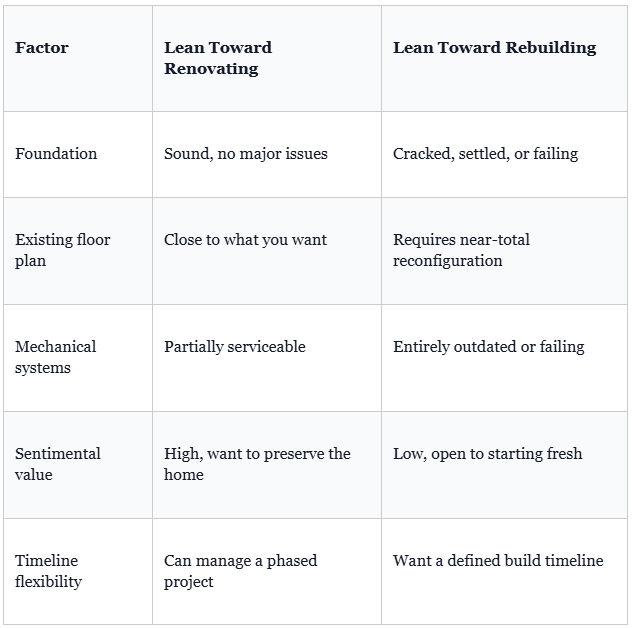
For some homes, the cost of a full renovation approaches or exceeds what a new custom build would cost on the same property. That's not always obvious until a contractor walks through and assesses what's actually needed.
In some cases, homes with significant foundational issues, extensive moisture damage, or floor plans that would require nearly complete reconfiguration to achieve the desired result may cost more to renovate than to rebuild. This calculation shifts further toward rebuilding when the existing home has limited heritage or sentimental value, and the lot itself has strong development potential.
A good builder will give you an honest assessment of both paths. The right answer depends on your attachment to the existing structure, the land, local zoning, and what your long-term vision for the property actually requires. If you're thinking through this question, the process of planning a custom home in Alberta covers many of the same early decisions.
How Does the Renovation Process Work from Start to Finish?
- Initial Consultation and Site Assessment: A contractor or design-build team walks the property, reviews the existing home's condition, and discusses your goals, budget range, and priorities. This is where rough project feasibility gets established.
- Design and Scope Development: Detailed drawings, material selections, and a full scope of work are developed. For structural changes, this phase may involve an engineer. This step takes longer than most homeowners expect, but it's what prevents costly changes later.
- Permit Applications: Permits are filed with the relevant municipality or county. Rocky View County and Foothills County have their own permitting offices with specific requirements, and timelines can vary. Work cannot legally begin on permitted scope until approvals are in place.
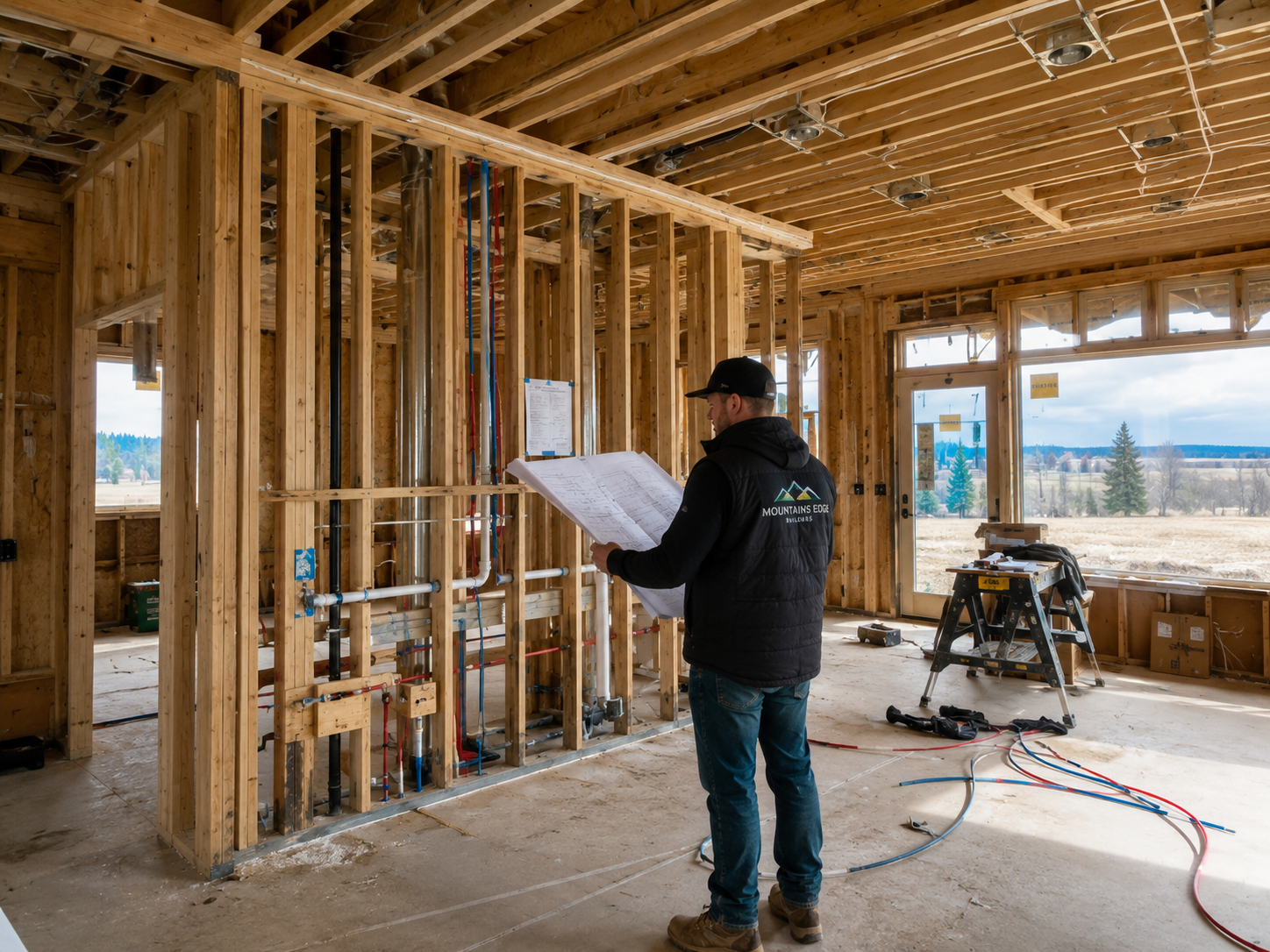
- Demolition and Rough-In: Existing finishes come out, structural changes are made, and rough mechanical work (electrical, plumbing, HVAC) is completed and inspected before walls close in.
- Inspections: Depending on the permit types, inspections occur at multiple stages. Framing, electrical rough-in, plumbing rough-in, and insulation are typically inspected before drywall goes up.
- Finishing Phase: Drywall, flooring, cabinetry, tile, painting, trim, fixtures, and final hardware are installed. This is the longest phase in most whole home projects.
- Final Inspection and Occupancy: Final inspections are completed, deficiencies are addressed, and the home is handed back to the homeowner. In a design-build model, a single team manages this entire sequence.
Common Mistakes Homeowners Make on Whole Home Renovations
- Starting construction before permits are issued. This can result in stop-work orders, required demolition of completed work, and complications when selling the property down the line.
- Underestimating the timeline. A whole home renovation in Alberta rarely completes in less than six months. Projects involving structural work, full mechanical replacement, and custom finishes often take longer, especially when permits, inspections, and trade availability are factored in.
- Choosing a contractor based on price alone. The lowest bid is rarely the best outcome on a complex renovation. Vague scopes of work, missing contingency planning, and limited trade coordination often explain why a bid looks attractive initially.
- Making major design decisions mid-construction. Changes after construction has started are significantly more expensive than changes made during the design phase. Spending more time on planning upfront almost always saves money overall.
- Not addressing mechanical systems as part of the renovation. Updating finishes without replacing aging electrical or plumbing means you'll likely need to open walls again within a few years.
Research on residential renovation projects consistently shows that design changes made after construction begins cost significantly more to implement than equivalent changes made during the pre-construction planning phase, with some estimates suggesting mid-construction changes can cost three to five times more than pre-build design revisions.
Why the Design-Build Model Works Well for Whole Home Projects
When design and construction are handled by separate companies, communication gaps are inevitable. The designer creates a vision. The contractor bids it. Discrepancies between what was designed and what can be practically built at a given budget often surface during construction rather than before it.
A design-build firm manages both phases under one roof, which means the person designing your renovation understands exactly what it costs and how it gets built. For a project as complex as a whole home renovation, that integration reduces surprises and keeps the project moving on a single accountable schedule. It also simplifies the homeowner experience considerably, since there's one team to communicate with rather than coordinating separately between an architect, a general contractor, and individual trades.
Industry surveys of homeowners who have completed major renovation projects consistently rank communication breakdowns and unclear accountability between designers and contractors as top sources of dissatisfaction, particularly on projects that involve both structural and cosmetic scope.
For homeowners on acreages in areas like Springbank, Bragg Creek, Priddis, or Millarville, there's an added layer of complexity. Rural builds require experience with well systems, septic servicing, site access planning, and county-level permitting that differs meaningfully from city renovation work. The design considerations for Alberta's climate also play directly into whole home renovations, particularly around insulation, HVAC sizing, and window performance in rural settings with greater temperature exposure.
Frequently Asked Questions
Do I need municipal permits for my whole home renovation in Alberta?
Yes, in most cases. Permits are required for any structural changes, electrical work, plumbing modifications, HVAC installations, and window or door enlargements. The specific permits required depend on your municipality or county. Rocky View County and Foothills County have their own development and building permit requirements that differ somewhat from City of Calgary regulations. Unpermitted work can create complications when you sell the property and may not be covered by home insurance if something goes wrong.
What should I know about Prepaid Contractor regulations in Alberta?
Alberta's Prepaid Contractors Act requires contractors who collect deposits or payments before completing work to be licensed under the act. This applies to renovation projects where money is collected prior to the work being done. Before signing any renovation contract, confirm that your contractor holds a valid Prepaid Contractor's License. This is a consumer protection measure designed to give homeowners recourse if a contractor fails to complete a project. Mountains Edge holds a Prepaid Contractor's License as part of its standard licensing requirements.
Are there rebates available for energy-efficient upgrades during a whole home renovation?
Federal and provincial programs have offered rebates for energy-efficiency improvements such as insulation upgrades, high-efficiency HVAC systems, windows, and heat pumps. Availability, amounts, and qualifying criteria change periodically, so it's worth checking directly with Natural Resources Canada and the Government of Alberta for current programs before finalizing your renovation scope. Your contractor may also be familiar with programs that apply to specific types of work.
Should I stay in the house or move out during a whole home renovation?
For a true whole home renovation that touches every major area of the house simultaneously, staying in place is rarely practical. Dust, noise, disrupted utilities, and limited functional space make daily life difficult and can actually slow the project down. If your renovation is being completed in defined phases, partial occupancy during later finishing stages may be workable. Discuss this directly with your contractor during the planning phase so temporary accommodation can be factored into your timeline and budget.
In what order should a full house renovation be completed?
The general sequencing follows a logical progression: structural and demolition work first, then rough-in of all mechanical systems (electrical, plumbing, HVAC), followed by inspections, then insulation and drywall, and finally all finishing work including flooring, cabinetry, tile, fixtures, trim, and paint. This order exists because finishing work can't happen until inspections clear, and inspections require visible rough-in work before walls are closed. Deviating from this sequence typically leads to rework and additional cost.
Ready to Plan Your Whole Home Renovation?
A whole home renovation is one of the most significant investments a homeowner can make. Getting it right means choosing a team with the experience to manage every phase, the honesty to tell you what the project actually involves, and the local knowledge to handle properties like yours.
Mountains Edge Home Builders has been working with homeowners in Rocky View County, Foothills County, and surrounding Southern Alberta communities since 2006. With more than 450 completed residential projects and a design-build process built around transparency and quality craftsmanship, the team is equipped to take on major home transformations from initial concept through final inspection.
If you're weighing a full renovation against a custom build, or you're ready to get serious about a major residential project, start with a conversation. Visit Mountains Edge Home Builders to learn more about the team's approach and to get in touch about your project.